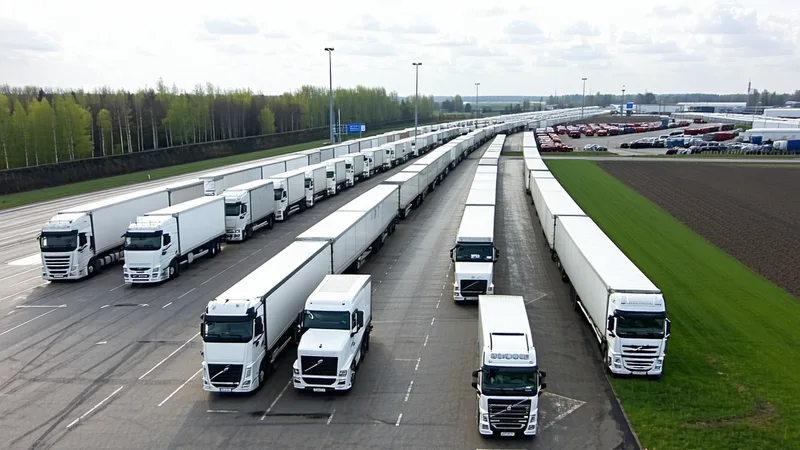
Poland has become one of the EU's most dynamic export economies over the past two decades. Polish manufactured goods — auto components, machinery, furniture, food products, chemicals — reach buyers across Western Europe, North America, and increasingly Asia. For Polish exporters, the trade finance landscape has specific characteristics: a PLN cost base paired with EUR or USD invoicing, a domestic banking sector that has historically been conservative in extending trade finance to mid-market exporters, and a strong growth trajectory that makes working capital management more critical as revenue scales.
Poland's Export Economy: Context
Poland's total merchandise exports have grown from approximately €130B in 2015 to over €300B by 2023, according to Polish Statistical Office (GUS) data. The top export categories include vehicles and transport equipment, machinery, electrical equipment, furniture, and food products. Germany is by far the largest export destination, accounting for roughly 28% of total exports — followed by Czech Republic, UK, France, and the United States.
The automotive supply chain is particularly significant: Poland hosts production facilities for Volkswagen Group, Fiat Chrysler (Stellantis), and numerous Tier-1 and Tier-2 suppliers. Polish auto-component manufacturers typically operate with long working capital cycles — raw material procurement 60–90 days before delivery, payment terms of 60–90 days on delivery, creating CCC of 90–150 days in some cases.
The PLN/EUR Currency Structure
Poland operates outside the eurozone, using the Polish zloty (PLN). However, a large proportion of Polish export invoicing is in EUR — particularly for sales to Germany, Czech Republic (CZK), and other EU markets. This creates a distinctive FX structure:
- Polish manufacturers with PLN cost bases selling in EUR are natural long EUR — they benefit when EUR/PLN is high (more PLN per EUR received) and are squeezed when EUR/PLN falls
- EUR/PLN has shown significant volatility: from approximately 4.20 in 2018, moving to 4.70 in 2020 (COVID), returning toward 4.25 in 2023. A 10% swing in EUR/PLN over a receivable cycle materially affects PLN profitability
- Interest rate differentials between the ECB and the National Bank of Poland (NBP) affect the cost of forward hedging — when Polish interest rates are significantly higher than eurozone rates, EUR forwards are at a discount relative to EUR spot
For Polish exporters invoicing in EUR with PLN costs, the FX management approach matters. Invoice financing advances can be disbursed in EUR and converted to PLN at the advance moment — allowing PLN cost obligations to be funded immediately without carrying EUR/PLN exposure through the payment tenor.
The Polish Banking Landscape for Trade Finance
Poland's banking sector is dominated by PKO BP, Bank Pekao, Santander Bank Polska, mBank, and ING Bank Śląski, among others. These banks provide trade finance products — documentary LCs, documentary collections, trade finance lines — but mid-market Polish exporters consistently report limitations:
- Facility limits tied to the Polish exporter's balance sheet rather than buyer creditworthiness — limiting access for growing companies with constrained net equity
- Requirements for collateral (real estate, machinery) that early-stage exporters may not have
- Processing times for LC applications and documentary collections that can run 2–4 weeks for first-time transactions
- Limited multi-currency flexibility for non-EUR, non-PLN payments (USD, GBP, CAD, AUD)
The Polish Export Credit Insurance Corporation (KUKE) provides state-backed trade credit insurance and export financing support for Polish exporters, particularly for larger transactions and for exports to higher-risk markets. KUKE-backed facilities can improve bank appetite, but the process is more suited to large structured transactions than to routine mid-market invoice cycles.
Common Trade Finance Structures for Polish Exporters
Open Account with Invoice Financing
The most common structure for Polish manufacturers selling to established Western European or US buyers. The buyer pays on net 45–75 day terms; the exporter finances the receivable through a platform like Tradevynt, receiving 90% advance within 24 hours of B/L or delivery confirmation. No buyer involvement required. Compatible with both EUR and PLN advance disbursement.
Documentary Letter of Credit
Used primarily for exports outside the EU/North America — Poland to Turkey, Middle East, North Africa, or Southeast Asia. Polish banks handle LC advising and confirmation. The documentary compliance requirements under UCP 600 apply — Polish exporters should verify that their documentation department is familiar with the precision required for LC presentations.
Documentary Collection (D/P and D/A)
Documents Against Payment (D/P) and Documents Against Acceptance (D/A) are used on some EU-EU and EU-Eastern European routes. Under D/P, the buyer receives the transport documents only against payment; under D/A, documents are released against the buyer's acceptance of a time draft. Less formal than an LC, lower cost, but provides less payment certainty — the collecting bank has no payment obligation.
Incoterms Patterns for Polish Exporters
For road freight within Europe (dominant mode for EU-EU Polish exports), the CMR (Convention on the Contract for the Carriage of Goods by Road) waybill replaces the ocean B/L as the primary transport document. CMR waybills are non-negotiable and do not represent title — invoice financing on EU road freight transactions uses the CMR plus invoice and purchase order as the documentation package.
For ocean freight (Polish exports to the UK, US, or further), standard ocean B/L practices apply. Polish Baltic ports — Gdańsk, Gdynia, Szczecin — handle significant container volumes. CIF is the preferred Incoterm for export financing because the Polish exporter retains control of the B/L and insurance through transit.
VAT Reclaim Timing: A Cash Flow Complication
Polish VAT applies at export: zero-rated for goods exported to non-EU countries, exempt within the EU under the reverse charge mechanism. However, input VAT on Polish-sourced materials and services is recoverable — and the reclaim process has historically created working capital timing problems. Polish VAT reclaims (zwrot VAT) can take 60–180 days in some cases, creating a cash drain that compounds the receivable working capital gap.
Export businesses should model the VAT reclaim timing into their working capital projections separately from the receivable cycle. Invoice financing addresses the receivable gap but does not accelerate VAT reclaims — these remain a separate working capital item requiring either a VAT loan facility or careful timing management.
Tradevynt's Coverage of Polish Export Markets
Tradevynt finances invoices from EU-registered exporters, including Polish registered companies. Invoice submission, documentation upload, and fund disbursement are available in PLN, EUR, and USD. Buyer approval covers buyers in the US, Canada, UK, Germany, Netherlands, France, Nordics, and Austria — the primary export destinations for Polish manufactured goods.
For Polish exporters shipping by road to EU buyers (without an ocean B/L), the platform accepts a CMR waybill plus confirmed delivery documentation as the advance trigger for EU-destination invoices. Confirm with the onboarding team whether your specific documentation package qualifies before committing to a submission.
Polish exporter looking for working capital support on your EU or North American receivables? Check eligibility or speak with our team about your specific export structure.